
How consumer robotics avoids navigation failures
How Consumer Robotics Avoids Navigation Failures
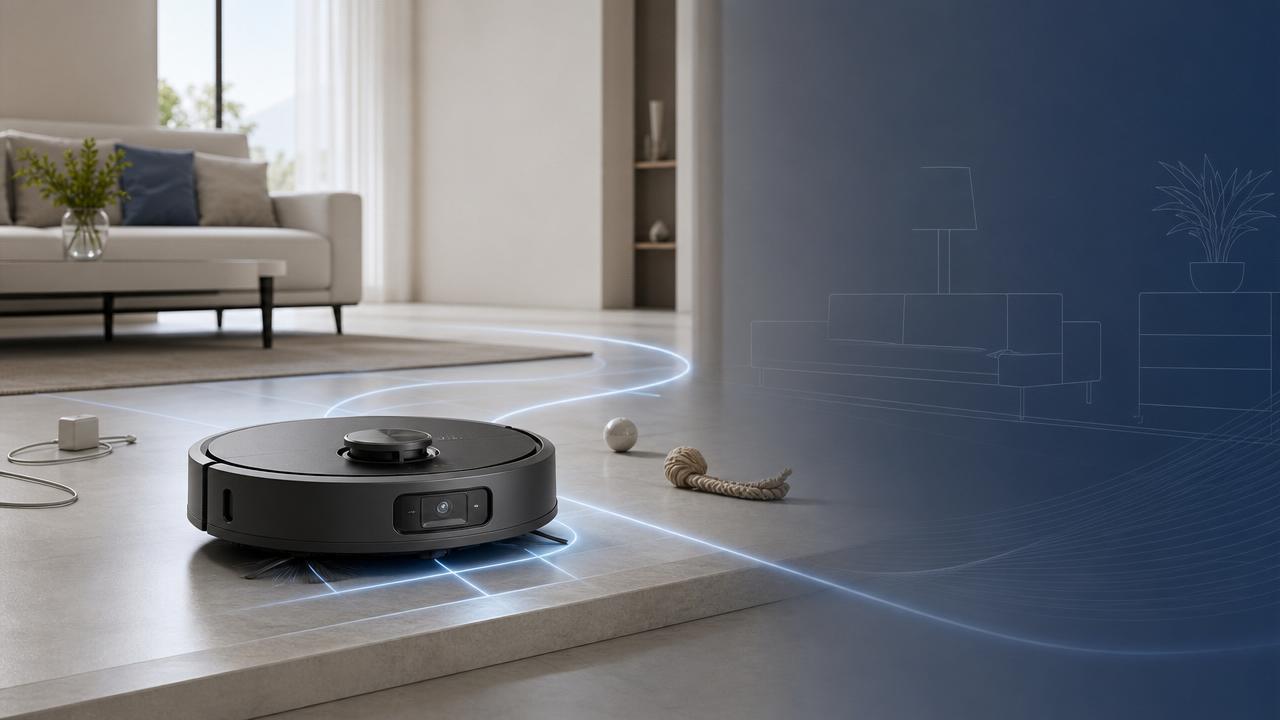
Navigation failures can turn promising devices into costly support cases, especially in consumer robotics where homes are dynamic, cluttered, and unforgiving test environments.
The real test is not one successful map. It is stable movement across pets, cables, reflective floors, low light, and changing layouts.
Modern consumer robotics reduces this risk through stronger perception, edge intelligence, redundant sensing, and user-centered recovery design.
Navigation Reliability in Consumer Robotics
In consumer robotics, navigation means understanding space, choosing a safe path, and recovering when reality contradicts the internal map.
This process usually combines localization, mapping, obstacle detection, path planning, motion control, and human feedback.
A robot vacuum, lawn mower, delivery cart, or pool cleaner may all face similar failure modes.
The challenge is that consumer environments are not controlled laboratories. They change by the hour.
A chair moves, sunlight hits a glossy floor, a pet drops a toy, or a child leaves a cable exposed.
Reliable consumer robotics therefore depends on resilience, not perfection.
The strongest systems assume partial sensor loss, ambiguous objects, wheel slip, and map drift will happen.
They avoid single-point decisions and continuously compare what sensors see against what the robot expects.
Industry Signals Behind Safer Navigation
The current consumer robotics market is shaped by higher expectations and lower tolerance for basic errors.
Smart cleaning robots are no longer judged only by suction, runtime, or app design.
They are judged by whether they avoid pet waste, cords, thresholds, dark corners, and fragile furniture.
These signals show why navigation has become a core quality marker in consumer robotics.
A device that cannot move predictably cannot deliver effortless chores, smart health, or outdoor convenience.
Sensor Fusion as the First Defense
Navigation failures often begin when one sensor lies, saturates, or loses useful data.
Consumer robotics avoids this by blending multiple sensing channels with different strengths and weaknesses.
- LiDAR provides distance geometry and supports stable indoor maps.
- RGB cameras identify semantic objects and surface details.
- Time-of-flight sensors detect nearby obstacles and drop-offs.
- IMUs estimate tilt, vibration, impact, and sudden motion.
- Wheel encoders track movement, while detecting slip against expected travel.
A single sensor can be fooled by mirrors, black carpets, glass doors, or bright sunlight.
A fused stack compares signals before making risky choices.
If LiDAR sees a wall but vision sees a doorway, the robot can slow and verify.
If wheels rotate but position does not change, the system can infer entrapment or slip.
This redundancy is essential for consumer robotics because support costs rise after every avoidable rescue.
SLAM Stability and Map Confidence
Simultaneous localization and mapping, or SLAM, lets a robot build a map while estimating its location.
In consumer robotics, SLAM must survive repeated cleaning cycles, moved furniture, and partial room access.
Map confidence is more important than a beautiful app drawing.
A reliable system assigns confidence values to walls, furniture, no-go areas, doors, and docking routes.
Low-confidence areas receive cautious speeds, wider clearances, or additional scanning passes.
High-confidence areas allow faster movement and more efficient route planning.
Loop closure is another critical element.
When the robot returns to a known place, it corrects accumulated position error.
Without loop closure, small odometry errors become visible path drift.
Advanced consumer robotics also separates temporary objects from structural features.
A laundry basket should not permanently rewrite a room boundary.
Obstacle Classification and Behavior Design
Avoiding navigation failure is not just seeing an object. The robot must know what kind of object it is.
Consumer robotics increasingly uses on-device AI models to classify common household hazards.
Behavior design turns perception into practical safety.
A soft obstacle may be pushed gently, while a cable should never be tested by force.
A reflective surface may require a slow verification pass instead of a sharp turn.
The best consumer robotics systems avoid dramatic reactions unless risk is high.
Recovery Logic After Navigation Errors
No navigation stack eliminates every error. The decisive factor is how quickly the robot recovers.
Recovery logic should be layered, transparent, and limited by safety boundaries.
- Pause motion and reassess sensor agreement.
- Reverse slightly if contact or compression is detected.
- Rotate slowly to refresh nearby geometry.
- Compare current features with the stored map.
- Choose retreat, re-route, or request help.
Consumer robotics should not repeat the same failed maneuver endlessly.
Repeated bumping, spinning, or docking attempts usually indicate weak state awareness.
A useful system records the failure context and adapts future routes.
For docking, recovery is especially important.
Auto-emptying and mop-washing stations demand precise alignment, controlled speed, and verified contact.
A failed dock can become a dead battery, unfinished task, or wet floor risk.
Business Value of Fewer Navigation Failures
Navigation reliability creates value beyond technical elegance.
For consumer robotics, fewer navigation failures mean fewer returns, fewer complaints, and stronger long-term trust.
A robot that rescues itself feels smarter than one with a slightly stronger motor.
This matters in direct-to-consumer hardware, where reviews can quickly shape demand.
Clear navigation performance also supports premium positioning.
Reliable AI obstacle avoidance is easier to explain than abstract processor specifications.
It also lowers hidden operational costs across warranty, app support, firmware triage, and replacement logistics.
In the CSOS view, navigation stability links algorithm quality with daily experience.
That bridge is central to modern consumer robotics and smart living hardware.
Typical Scenarios Requiring Robust Navigation
Different product categories expose different navigation risks, but the design principles remain consistent.
The most valuable systems combine category-specific sensing with shared navigation discipline.
That discipline includes conservative motion near uncertainty and clear escalation when autonomy is unsafe.
Practical Design and Evaluation Priorities
Reliable consumer robotics requires testing that reflects real homes, not only clean demo rooms.
- Test reflective floors, black rugs, glass doors, and mixed lighting.
- Measure recovery time, not only obstacle detection accuracy.
- Track false avoidance, since overcautious robots leave work unfinished.
- Validate docking after long runs, partial maps, and low battery states.
- Keep privacy controls clear when cameras support navigation.
- Use firmware updates to improve models without changing user habits.
Evaluation should include both quantitative metrics and visible user outcomes.
Coverage rate, stuck frequency, collision force, map drift, and successful docking all matter.
So do understandable alerts, editable maps, and simple no-go zone controls.
Consumer robotics succeeds when technical recovery feels calm, predictable, and almost invisible.
A Clear Path Toward Dependable Autonomy
Navigation failure is rarely caused by one weak component.
It usually appears when perception, mapping, planning, motor control, and user feedback are not aligned.
The next step is to treat navigation as a full system property.
Start with realistic scenario testing, then review sensor redundancy, SLAM confidence, object behavior, and recovery logs.
CSOS tracks these layers across smart cleaning, outdoor automation, micro-mobility, and connected living systems.
For any consumer robotics roadmap, the practical goal is simple.
Build machines that move with enough intelligence to avoid trouble, and enough humility to recover when trouble appears.
Related News
- How SLAM Navigation Helps Robot Vacuums Map Rooms and Track Their PositionExplore SLAM navigation robots for smart appliances. Learn how robot vacuums map rooms, track position, and correct drift—and discover what to look for in reliable cleaning.Time : Oct 23, 2026
- Benchmarking Cleaning Robot Solutions: KPIs for Selecting Facility-Ready SystemsSolution benchmarking cleaning robots: compare coverage, cleaning quality, uptime, safety, maintenance, and total cost to select a facility-ready system with confidence.Time : Sep 29, 2026
- Choosing a Robot Vacuum and Mop for North American Homes: Floors, Pets, and Dock NeedsRobot vacuum and mop North America guide: compare floor types, pet-hair performance, navigation, carpet handling, and dock features to find the right fit.Time : Sep 27, 2026