
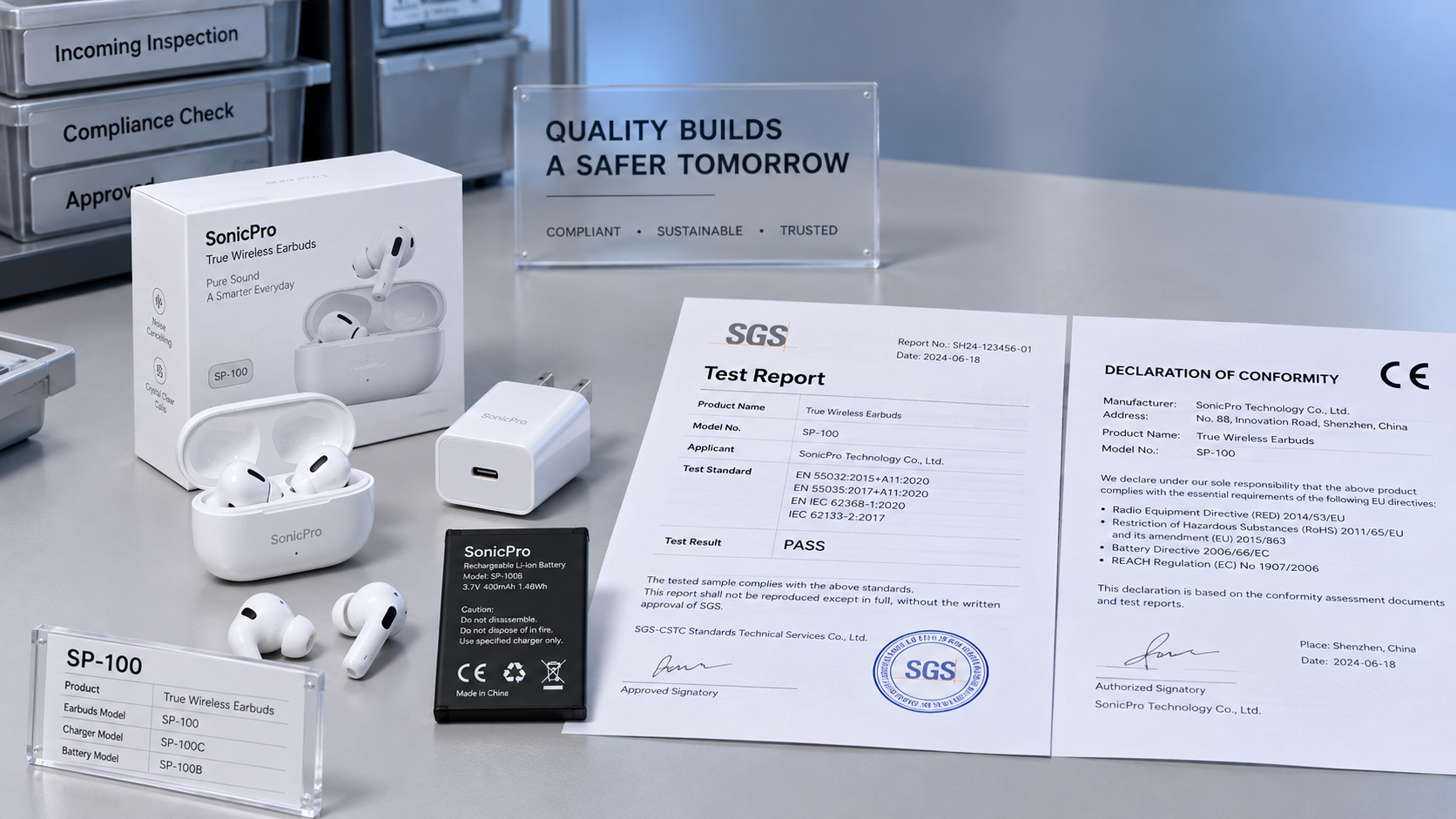
A supplier’s compliance logo cannot protect your next electronics order from customs delays, marketplace rejection, or costly recalls. Buyers need evidence tied to actual products.
For procurement teams navigating consumer product sourcing electronics, the strongest safeguard is checking every document against the exact model, destination market, and supplied configuration.
Start with applicable declarations, authorization records, safety reports, and battery transport evidence. Then verify authenticity, technical coverage, labeling, and responsibility before committing significant purchase funds.
This guide explains which documents to request, how to evaluate supplier evidence, and which gaps should pause purchasing until the supplier provides a credible resolution.
Which documents should buyers request before approving a supplier?
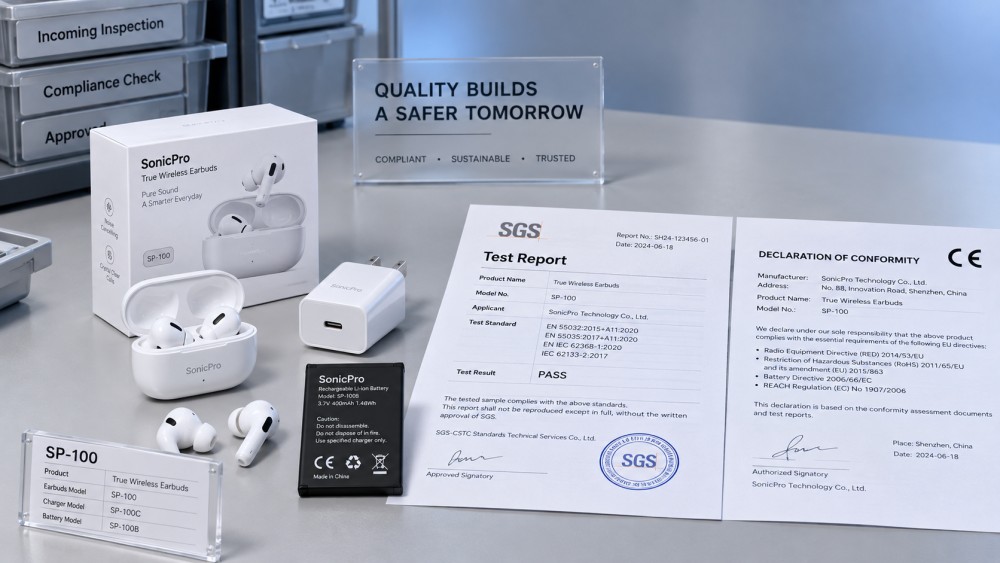
Request a compliance file for each product configuration and destination market. A folder labeled “certificates” rarely establishes whether the goods you receive satisfy applicable requirements.
The initial request should identify the finished product, supplied charger, battery pack, wireless functions, accessories, intended use, and every country where sales are planned.
Use the following matrix as a screening tool. Applicability depends on product characteristics and local rules; every row does not apply to every purchase.
Ask suppliers to map each document to your purchase specification. This prevents a valid report for one regional variant from supporting an incompatible shipment.
For connected appliances, separately assess cybersecurity, privacy, and software obligations. Electrical testing alone cannot demonstrate compliance with requirements governing wireless connectivity or handling personal information.
Set document deadlines before deposits, production approval, and shipment. Procurement gains negotiating power when evidence requirements become contractual acceptance criteria before commercial commitments are finalized.
Does the evidence cover the exact product you will receive?
Model identity is the first verification gate. Compare the quotation, purchase order, rating label, packaging, declaration, and report against one approved product specification sheet.
Check model suffixes, voltage, frequency, rated power, battery capacity, charger output, plug type, and radio modules. Small differences can change which evidence remains applicable.
Request report photographs and critical component lists where available. Compare the enclosure, circuit board, battery, protective devices, and power supply with an approved sample.
A report covering a product family can be legitimate. However, the documentation should explain which variants are included and how relevant construction differences were evaluated.
Private labeling requires additional care. Obtain documented links between the original tested model, your branded designation, and the entity responsible for applicable declarations and markings.
For example, a robot vacuum supplied with a different charging dock may need further assessment. Matching the robot’s commercial name does not establish dock coverage.
Require written approval before substitutions involving cells, battery management systems, chargers, motors, plastics, or radio hardware. Changes can invalidate assumptions behind previously acceptable evidence.
For EU sales, what makes a Declaration of Conformity credible?
An EU Declaration of Conformity is the manufacturer’s legal declaration that a product meets applicable requirements. It is not a generic certificate issued by customs.
Check the manufacturer’s identity and address, product identification, relevant legislation, referenced standards, signatory details, and date. Missing or inconsistent information warrants investigation before approval.
The legislation must fit the product. Radio equipment generally requires assessment under the Radio Equipment Directive, while other electrical products may follow different applicable frameworks.
Do not insist that every wireless appliance separately lists the Low Voltage and EMC Directives. Radio equipment legislation incorporates relevant safety and electromagnetic compatibility requirements.
Ask for reports supporting the declaration and confirmation that required technical documentation exists. A polished declaration cannot compensate for irrelevant testing or an unassessed configuration.
CE marking often follows manufacturer self-assessment under applicable procedures. A notified body is required only where the relevant legislation and conformity assessment route demand one.
Verify any claimed notified body through the European Commission’s NANDO system. Confirm its designation covers the relevant legislation and activity, rather than trusting its logo.
For other destinations, build separate requirements. Great Britain and Northern Ireland have distinct arrangements, and buyers should confirm current marking and recognition rules before shipment.
For US sales, which FCC and safety records matter?
FCC compliance concerns radiofrequency emissions and related technical requirements. It does not establish electrical safety, battery safety, or suitability for every intended operating environment.
Determine whether the equipment requires certification, a Supplier’s Declaration of Conformity, or another applicable treatment. Many intentional radiators require certification, while numerous digital devices use SDoC.
When certification applies, search the FCC equipment authorization database using the FCC ID. Compare the grantee, equipment description, frequency bands, exhibits, and grant conditions.
A certified wireless module can simplify assessment, but integration conditions still matter. Antenna changes, installation restrictions, RF exposure, host emissions, and labeling require separate attention.
For equipment using SDoC, request supporting test evidence and required compliance information. Confirm the responsible party meets applicable US requirements rather than demanding an FCC ID.
Assess product safety separately. UL or ETL certification may be required by a retailer, insurer, local authority, or specific law, depending on the product.
A statement saying “tested to UL” does not prove active product certification. Verify the certification listing, model coverage, manufacturing location, and authorization to display marks.
For e-bikes and scooters, distinguish battery certification from complete electrical system certification. Check destination-specific rules, including local requirements that may exceed general federal expectations.
What battery documents are essential for transport and product safety?
For lithium-powered products, obtain the applicable UN 38.3 test summary and confirm it identifies the cell or battery design used in your actual shipment.
Compare the manufacturer, model, physical description, mass, watt-hour rating or lithium content as applicable, laboratory details, report reference, and documented test outcomes against supplied batteries.
A safety data sheet does not replace UN 38.3 evidence. Likewise, transport testing does not establish that a battery is safe within the finished product.
Request underlying reports when necessary to resolve inconsistencies or higher-risk configurations. Clarify whether supplied evidence covers cells, assembled packs, or both, as applicable to shipment.
Product safety assessment should address the pack, charger, protection electronics, thermal behavior, and foreseeable misuse. A portable power station requires more than cell-level documentation.
Confirm shipping classification, packaging, marks, labels, and transport documents with a qualified dangerous goods provider. Requirements differ for standalone batteries, packed batteries, and installed batteries.
Air, sea, and road transport have different rules and restrictions. Obtain shipment-specific confirmation, including applicable charge limits, rather than relying on a supplier’s previous delivery.
Pause approval if a supplier changes cell manufacturers without assessment. Similar capacity and dimensions do not establish equivalent safety performance or continued transport test coverage.
How should buyers evaluate chemical, labeling, and environmental evidence?
For EU electrical equipment within scope, RoHS evidence should address restricted substances in relevant homogeneous materials. A vague “environmentally friendly” statement provides little purchasing assurance.
Ask which components and materials the assessment covers, which exemptions apply, and how supplier declarations or laboratory testing support the conclusion for the finished product.
REACH requires a different assessment. Review applicable restrictions and substance communication duties, including Candidate List substances where relevant, rather than treating RoHS evidence as interchangeable.
A laboratory report reflects a defined sample and assessment date. Ask how the supplier monitors regulatory updates and component changes that could affect continued compliance.
Review actual label artwork and manuals before production. Check required identifiers, ratings, warnings, language, disposal symbols, and responsible economic operator information for the destination.
Connected products may also need evidence addressing applicable cybersecurity requirements. Assess the launch date, market, device functions, and support commitments before finalizing the compliance plan.
Confirm environmental registrations separately where applicable, including electrical equipment, batteries, and packaging. These obligations can attach to the importer or brand rather than the factory.
How can procurement teams authenticate reports and identify purchase blockers?
Contact the laboratory or certification body through independently verified contact details. Ask it to confirm the report number, applicant, model coverage, and document authenticity.
Check accreditation scope where accredited testing is claimed. An ISO/IEC 17025 accreditation logo alone does not establish competence for the specific tests your product needs.
Read the results and report limitations. A cover page may omit failures, deviations, untested functions, restricted configurations, or conditions that determine whether evidence is usable.
Older reports are not automatically invalid, and newer reports are not automatically sufficient. Evaluate product changes, applicable requirements, standards transitions, and any certification maintenance conditions.
Reject unsupported explanations for altered model numbers, missing report pages, inconsistent photographs, or unverifiable issuers. These problems undermine the connection between evidence and purchased goods.
Classify unresolved safety failures, missing required authorizations, battery identity mismatches, and suspected falsification as purchase blockers. Resume approval only after documented resolution and appropriate reassessment.
Handle correctable artwork or translation issues through controlled revisions with deadlines. Keep them open until approved files match production labels, packaging, and supplied instructions.
What should the final purchasing decision require?
Approve a purchase when evidence covers the exact configuration, destination obligations are understood, document authenticity is credible, and unresolved issues have clear owners and deadlines.
Include approved components, document delivery, substitution controls, inspection rights, and corrective action responsibilities in the purchase agreement. Define remedies with appropriate commercial and legal review.
Before releasing shipment payment, compare production samples and labels against the approved file. Confirm that any manufacturing changes received the required technical review and acceptance.
Retain declarations, reports, approval records, shipment details, and revision histories in an accessible compliance file. Traceability makes marketplace inquiries, authority requests, and corrective actions easier.
Effective consumer product sourcing electronics connects documents to real hardware. Purchasing confidence comes from verified scope, accountable suppliers, and evidence maintained throughout the product lifecycle.